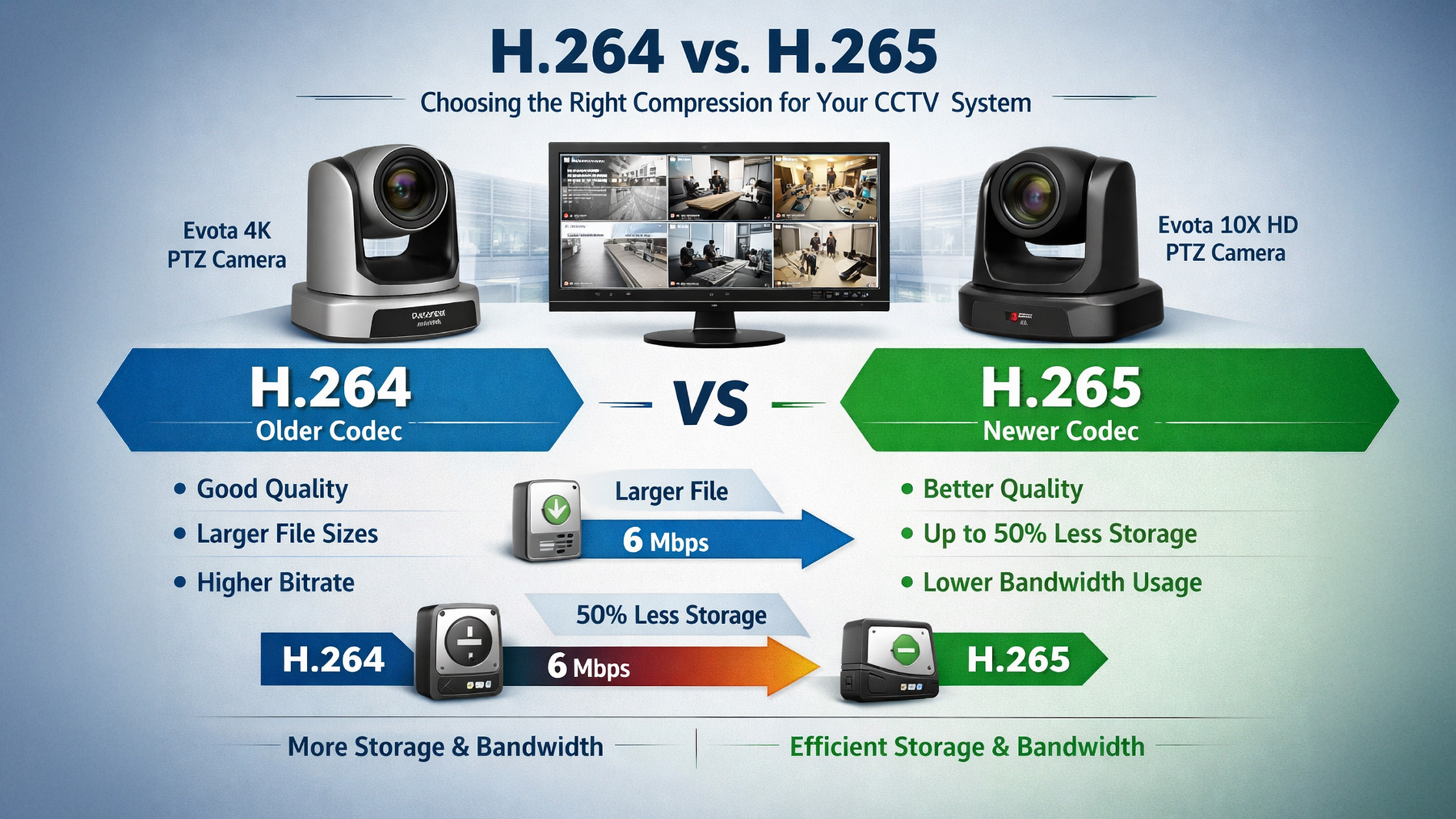
In today’s security-driven world, CCTV systems are no longer optional—they are mission-critical. From corporate offices and factories to schools, retail stores, and smart classrooms, high-resolution video surveillance has become the backbone of safety and monitoring. However, higher resolution also means larger video files, higher storage costs, and increased bandwidth usage. This is where video compression technologies like H.264 and H.265 play a crucial role. At GoLive eTechnologies India Private Limited, we offer advanced surveillance and AV solutions—including Evota 4K PTZ cameras, Evota 10X HD PTZ Camera, and professional CCTV setups—designed to deliver maximum clarity with optimized data usage. This guide explains the difference between H.264 and H.265, helping you choose the right compression standard for your CCTV investment.
What Is Video Compression in CCTV?
Video compression reduces the size of video files by removing redundant data while maintaining visual quality. Efficient compression ensures:
Lower storage cost
Reduced network bandwidth usage
Smooth remote viewing
Long-term scalability
Most modern CCTV systems today rely on H.264 or H.265 (HEVC) compression standards.
H.264 Compression: The Industry Standard
What Is H.264?
H.264 (also known as AVC – Advanced Video Coding) has been the most widely used video compression format for CCTV, streaming, and broadcasting for over a decade.
Key Benefits of H.264
Excellent compatibility with DVRs, NVRs, and browsers
Stable performance for Full HD (1080p) cameras
Lower hardware requirements
Affordable implementation
Ideal Use Cases
Small offices & retail stores
Legacy CCTV systems
Budget-friendly surveillance projects
At GoLive, many Evota camera price-optimized models and entry-level CCTV solutions support H.264 for reliable performance.
H.265 (HEVC): Next-Generation Video Compression
What Is H.265?
H.265—also known as HEVC (High Efficiency Video Coding)—is the successor to H.264. It delivers the same video quality at nearly 50% less bitrate.
Key Benefits of H.265
Up to 50% storage savings
Ideal for 4K & Ultra HD CCTV cameras
Reduced network congestion
Longer video retention without increasing hard drive size
Ideal Use Cases
Large campuses & enterprises
Smart classrooms & institutions
City surveillance & traffic monitoring
24×7 recording environments
Evota 4K PTZ Camera, Evota 4K Camera, and Evota PTZ Camera Price-efficient models from golive etechnologies fully support H.265, making them future-ready investments.
H.264 vs H.265: Quick Comparison Table
|
Feature |
H.264 |
H.265 |
|---|---|---|
|
Compression Efficiency |
Standard |
Up to 50% better |
|
Storage Requirement |
Higher |
Lower |
|
Bandwidth Usage |
Higher |
Optimized |
|
Ideal Resolution |
Up to 1080p |
4K & Ultra HD |
|
Hardware Requirement |
Low |
Moderate |
|
Cost Efficiency (Long Term) |
Moderate |
High |
Which Compression Should You Choose?
Choose H.264 If:
You are upgrading an existing CCTV system
You use Full HD cameras
You want lower upfront cost
Choose H.265 If:
You are installing Evota 4K PTZ Camera
Storage cost matters
You need long-term scalability
You run multiple cameras simultaneously
GoLive Technologies helps customers across Delhi NCR and India-wide select the most cost-effective compression strategy based on camera count, resolution, and storage goals.
GoLive eTechnologies: Optimized CCTV & AV Solutions
At golive etechnologies, we don’t just sell products—we design complete surveillance ecosystems.
Our Popular Surveillance Solutions Include:
Evota 4K PTZ Camera (H.265 supported)
Evota 10X HD PTZ Camera
Evota Camera Price-optimized CCTV models
Logitech PTZ Camera for conferencing
HDMI Video Capture Device Software for monitoring
Online class studio setup & teaching studio setup
Each solution is engineered to deliver:
Lower total cost of ownership
Better image clarity
Faster remote access
Long-term storage efficiency
Pricing & Value Perspective (India)
While H.265-enabled cameras may cost slightly more initially, they help save significantly on:
Hard disk upgrades
Network infrastructure
Cloud storage plans
This makes Evota camera price vs performance highly competitive in the Indian market.
Your email address will not be published. Required fields are marked *
By Inhype • September 12, 2026
A smart classroom is only as effective as the technology supporting it. Interactive panels, smart boards, PTZ cameras, microphones, speakers, PCs and
Read More
By Inhype • September 12, 2026
Higher education is rapidly moving beyond traditional chalkboards and projectors. Today, colleges and universities need technology that supports inter
Read More
By Inhype • September 12, 2026
A smart classroom for CBSE schools is no longer simply a classroom with a digital board. Modern schools are building connected learning environments t
Read More
By Inhype • September 12, 2026
Planning a smart classroom project for 10, 20 or even 50 classrooms requires more than simply purchasing digital boards. Schools, colleges, universiti
Read More
By Inhype • September 12, 2026
A smart classroom can transform the way teachers explain concepts, students interact with lessons, and institutions deliver digital education. From in
Read More




Golive eTechnologies India Private Limited (CIN - U31909UP2021PTC148242) is one of India's leading providers of smart classrooms, interactive boards, video conferencing solutions, and display technologies for the education, healthcare, corporate, and government sectors.









No comments yet. Be the first to comment!